San Telmo Market

On Sundays the San Telmo Market is bustling with activity, There are produce stalls and jewelry shops and dozens of restaurants. The building itself is reminiscent of a French market, with an iron framework and colorful glass. We wander through the market, but nothing is very appealing. The fruits and vegetables seem tired, and a lot of the shops are selling junk. The restaurants appear to be the main attraction. We buy some nice pastries.

San Telmo Market

Diners at the Market

As we exit the market, there is a nearby restaurant in an old Monastery where we stop for lunch. The Monastery is beautiful, with tile work and statuary, and we sit at a shaded table along one of the galleries. The service is very slow. We get our drinks, then wait. Then we wait some more. We’re not sure our waiter has put in our order. We ask, but he doesn’t speak English, and it’s not clear he understands. We wait. Diners around us have ordered, been served, eaten and left. Finally our food arrives. Fries, empanadas and a frittata. It’s just OK. Nice place to visit, but like the market it doesn’t live up to its promise.

The Monastery

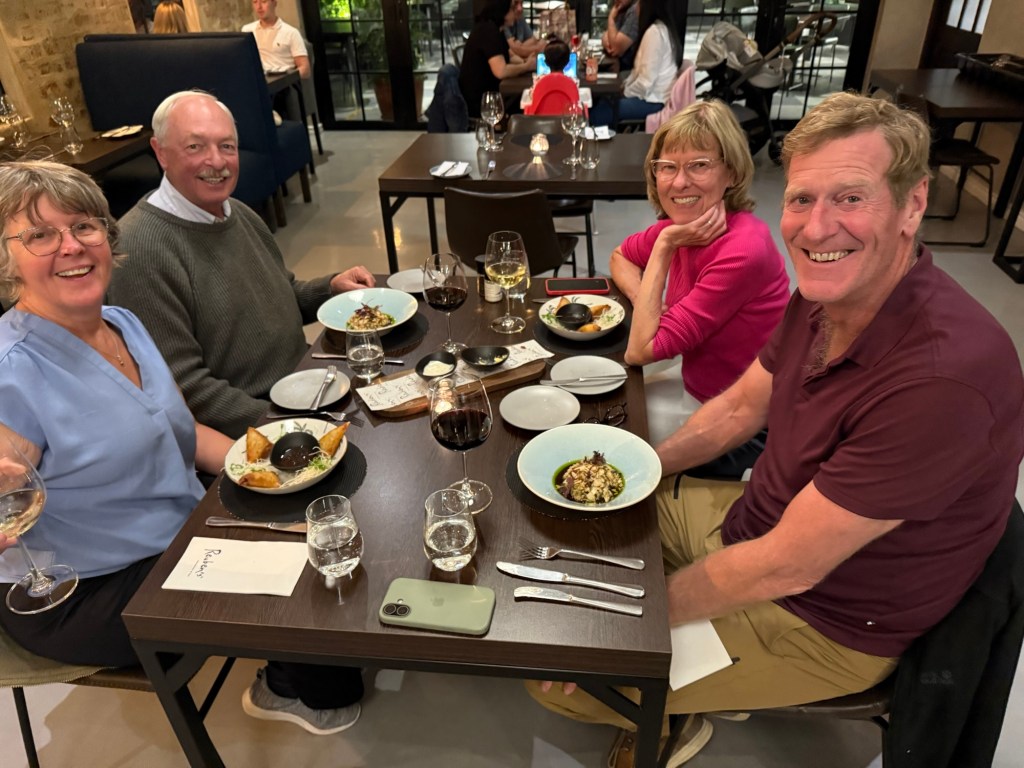
At Our Table

We Uber back to the apartment for our now routine nap. The midday heat in Buenos Aires makes it difficult to stay outside. By late afternoon things start to cool down, and we walk to the grocery store to find some dinner. Sausages for the grill seem right, along with a nice salad and sautéed broccoli. We have an electric grill that works quite nicely, and after a drawn out cocktail hour we cook and have dinner al fresco. This our last night in Argentina. The warm breeze and summer sky are perfect. At home it’s minus 4°.

Farewell to BA

Winding Down

Our sojourn in the Southern Hemisphere is rapidly approaching the end. We’ve seen Argentina top to bottom, and made forays into Chile, Uruguay and Brazil. From the cold of Ushuaia to the tropical jungle of Brazil it’s been quite a journey. We have two more nights in Buenos Aires, and today we’re going to the Parque Tres de Febrero, also known as Palermo Woods, regarded as the best park in the city. Tonight we’re going back to the Tango Porteño since Patty and Steve have not seen a Tango show yet.

Palermo Woods is famous for its rose garden and beautiful small lakes.

Rose Gardens

And Small Lakes at Palermo Woods

After walking through the gardens and enjoying the beautiful summer sunshine, we found ourselves outside a nice little restaurant called Celine, and stopped for lunch.

Celine

After a pleasant lunch we went back for a nap. Tango Porteño begins at 8 PM, but we were there early, so we walked around the Obelisco and enjoyed the cool evening breeze.

At the Obelisco

At the show

The Tango show was again spectacular, and the meal was decent. Tango Porteño is more like a Broadway production than a typical Tango show, and in retrospect I would have liked to see a smaller show in a more intimate setting. As one of our tour guides said, Tango shows are for the tourists. Tango culture is very much alive in Argentina, with its own unique atmosphere, usually very late into the night.

Tango

Porteño

After midnight was late enough for us, and we Uber’d home to sleep.

A Cooking Class

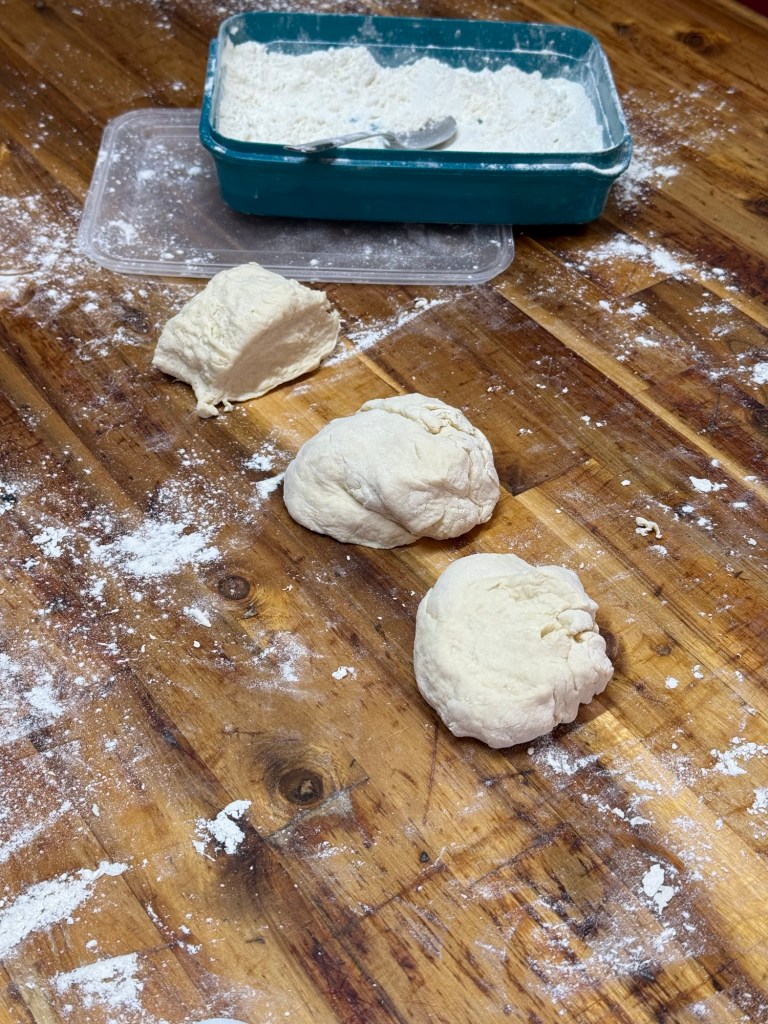
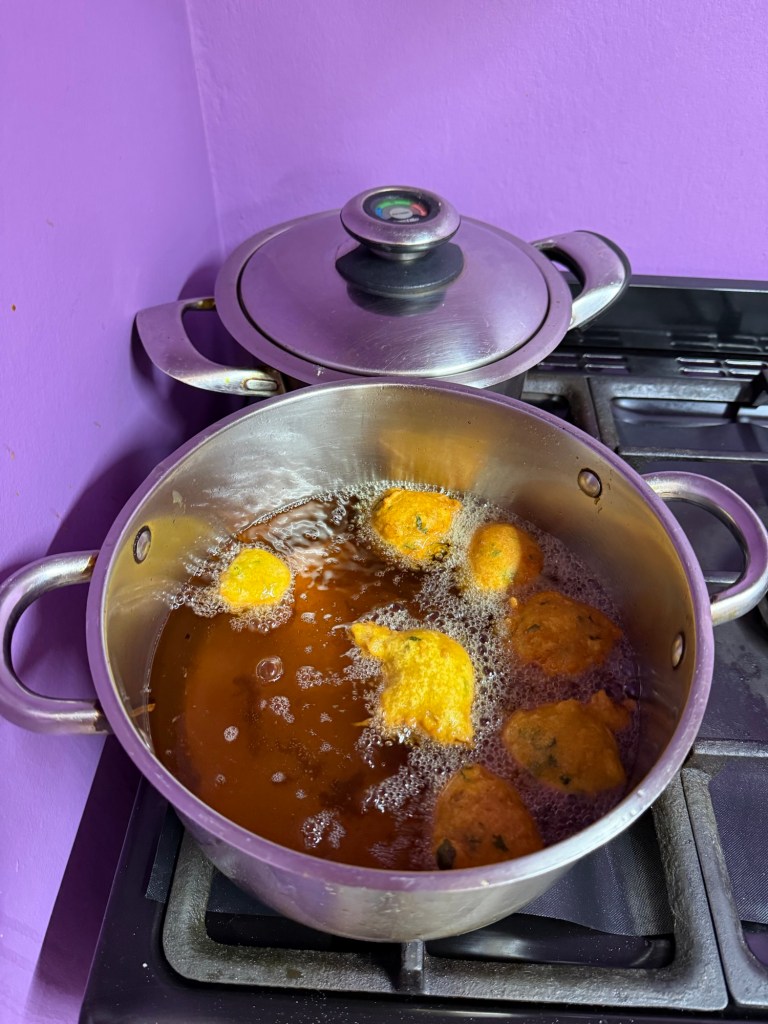
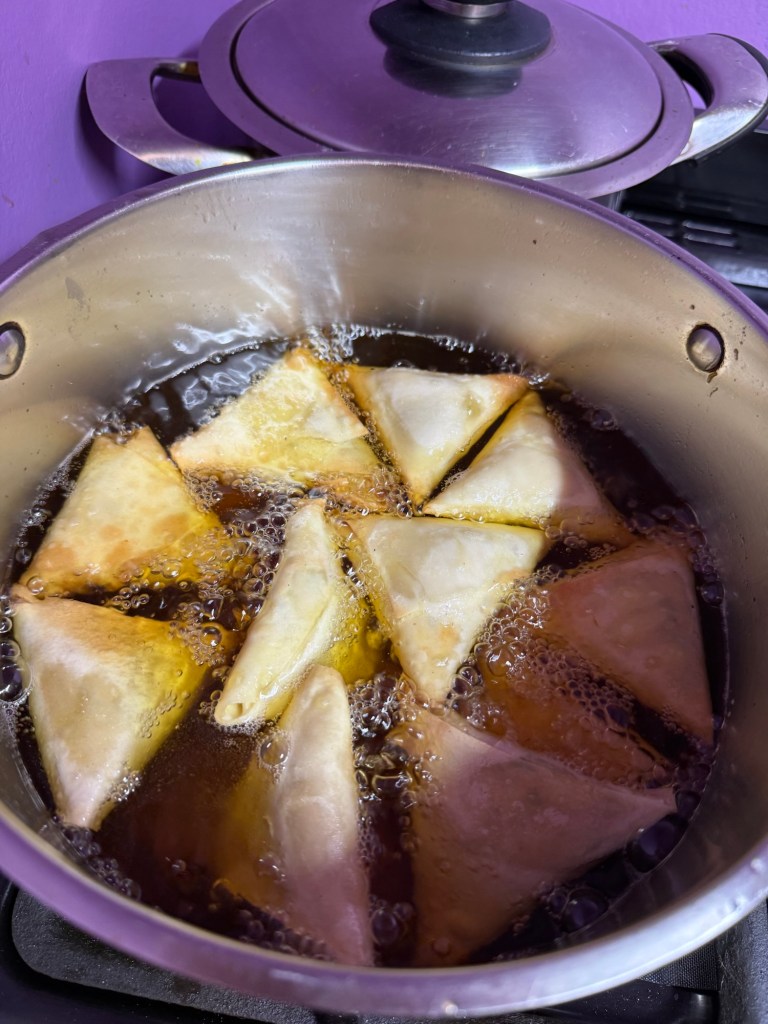
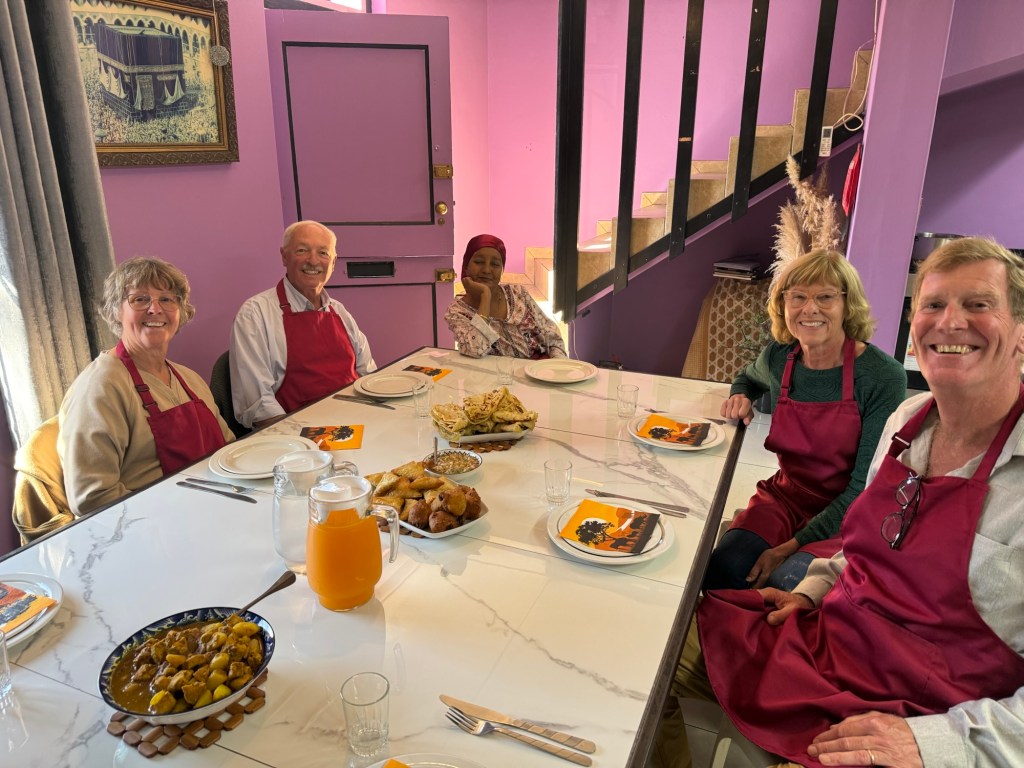
Yesterday we took an Argentine cooking class to learn about and prepare some traditional Argentine food, including empanadas, a squash stew, and Dulce de lèche crepes. The place is called Pachamama, and our chef/instructor Fran was great. After three hours of cooking we feasted on our efforts.

Making Squash Stew

Flipping Crepes

Filling the Empanadas

Time to Eat

One thing we’ve learned in our travels in Argentina is that spices are seldom used. We assumed Latin America would be spicy and flavorful, But we were wrong. Even salt and pepper are often omitted and the food can be quite bland. At Pachamama we did use more spices and the result was much better flavor. We made a delicious chimichuri sauce for the empanadas and they were fantastic. There is an art to filling the empanadas, and different fillings require different folds. You can actually identify the filling just by looking at the way the crust is folded.

Carne Empanadas- look at the folds

The class and subsequent meal demanded a siesta to digest and recover. The weather has turned cooler and pleasant, and after our siesta we spent a relaxing evening on our patio, sipping Vermouth spritzers and enjoying the summer sky. A flock of noisy parakeets joined us briefly, before flying off looking for food.

Maroon Bellied Parakeet

A Night Ride in Buenos Aires

We’d had intermittent rain throughout the afternoon, and the temperature dropped to a comfortable 80 degrees with a cooling breeze when we started our nighttime bike ride. Buenos Aires is one of the first cities in Latin America to have established bicycle lanes throughout the city. They added extensively to the system during Covid.

We’re signed up for a three hour tour through the central city, with a stop for ice cream. Our tour guide Ricardo, or Ricky, is a former flight attendant and Tango aficionado, originally from Honduras. He’s entertaining and a bit odd. We ride the streets at a leisurely pace, crossing some major intersections cautiously. The drivers are uniformly courteous, and you hear very few horns as we progress.

Seeing the city at night is fun, and Ricky shares some good history with us. We ride to El Obelisco de Buenos Aires, where Argentines meet in huge crowds to celebrate or protest. Six million people gathered here in 2022 when Argentina won the World Cup. It looks as if someone put the Washington Monument in the middle of Broadway.

El Obelisco

We then bike to the Casa Rosada and the Plaza de Mayo. The Casa Rosada is the official residence of the Argentine President, while the Plaza de Mayo is famously the site of demonstrations against the military dictatorship in the late 1970’s. Mothers of the disappeared would walk two by two around the Plaza to protest the government’s taking of over 30,000 citizens, most of whom were killed.

Casa Rosada

Symbols of the Disappeared at Plaza de Mayo

Our tour then crossed the bridge to the Puerto Madero neighborhood, which is the Gold Coast of the city, with elegant high rise buildings along the waterfront.

Puerto Madero

Puerto Madero

We stopped outside the Ministry of Culture to admire a statue of Juana Azurduy de Padilla, who was a female military commander in the wars of independence against Spain. She famously fought while pregnant, and returned to the fight immediately after giving birth. She is a feminist icon in Argentina.

Juana Azurduy de Padilla

Our final stop is for ice cream near the Plaza San Martin. Delicious!

Évita

“Don’t cry for me, Argentina
The truth is, I never left you
All through my wild days, my mad existence
I kept my promise
Don’t keep your distance”

Most Americans are familiar with Eva Perón only because of the Broadway musical ‘Évita’ and the movie starring Madonna, but she is an icon in Argentina. She was born in the small town of Los Todos in the Argentine Pampas, and moved to Buenos Aires at 15 to pursue a career in entertainment. She met and married Colonel Juan Peron just as he was rising in the government and in 1946 was elected President.

She was very active politically and supported services for the poor and voting rights for women. Tragically she died of cervical cancer at age 33 in 1952. Mourners filled the streets for days. Flower shops sold out. Her body was embalmed and put on display at the Presidential Palace. Then Juan Peron was ousted in a military coup and fled to Spain. Evita’s body disappeared.

It was found ten years later in a cemetery in Italy, and reunited with Juan, who put it on display in his dining room in Spain. When he was again elected President in 1973 she was brought back to Argentina, and is now buried in a family plot in Recoleta Cemetery.

Évita Perón’s Tomb
And her plaque

The Recoleta Cemetery is the final resting place of many of the Argentine elite, including military leaders, politicians and writers. Elaborate monuments with beautiful statues are everywhere, but some of the crypts are in need of restoration, and sadly some of the buildings are badly neglected.

An Eerie Tomb

We walked the cemetery for about an hour, then headed back to the apartment. It has rained intermittently over the past two days, but we have a night bike ride scheduled for this evening and hopefully things will settle down.

Back in BA

The purported airport workers strike didn’t affect our travel, and we flew back to Buenos Aires from Iguazu Falls yesterday. That was our 8th flight since arriving in Argentina, and our last. Melissa’s sister Patty and husband Steve have rented a nice apartment in the Recoletta neighborhood for three weeks, so we’re settled in for a week with them.

The Apartment

The Patio

We’ve got several exciting events scheduled for this week. Today we’re going to a Maté tasting to learn more about this traditional Argentine beverage. Tomorrow evening we’re going on a bike ride through Buenos Aires with a guide. Thursday it’s a cooking class.

Our Maté tasting includes a discussion of the history of Maté, which was first used by the indigenous Guarani people of the Iguazu Falls region over 2500 years ago. Today it is grown primarily in that region of Argentina and Brazil, where it is a large shrub. The branches and leaves of the plant are harvested, dried, ground and aged for 6 months to two years to make the Maté. It is a very social drink, served in a Matè cup with a metal straw called a bombillá which is shared communally.

Maté cups and Bombillás

Maté contains caffeine in amounts more than coffee, but is consumed in small quantities at a time, and many people drink it throughout the day for energy and focus. Famous maté drinkers include soccer star Lionel Messi, Pope Francis, and actor Viggo Mortensen.

Maté Drinker’s Hall of Fame

Our Maté Guide Robertó

After our tasting we walked to nearby Florida Street for some shopping, which was interrupted by an afternoon downpour. We Uber back to the apartment, still hyped up from the Maté. No nap likely today.

Robertó and Melissa

Foz do Iguaçu Brazil

We’ve seen the falls from the Argentine side, and from the Brazilian side at night. Before breakfast this morning, and before the crowds arrive, we walk along the path to get a good look at the falls from Brazil. The views are spectacular, and each turn of the trail reveals new cataracts not seen before.

Iguaçu Falls from Brazil

And a Rainbow

After our walk we are ready for breakfast, and the hotel does not disappoint. Exotic fruits, fancy pastries and made to order omelets with smoked salmon and crème fraîche. Also Bloody Mary’s and Mimosas. And Energy shots.

Exotic Fruits

Pastry with Mandarin Orange Jelly

We have our share, then walk the grounds of the hotel and climb the tower for a panoramic view.

In the Tower

In the late afternoon the sky clouds over. It begins to rain. The temperature drops from a high of 93° F to a more pleasant 88°. We watch the rain and play on our phones. I’m glad I did the moon walk last night.

Earlier in the day as we were sitting by the pool I heard a rustling in the garden near the fence. I looked to see an enormous black and white lizard hiding there. He saw me and took off. According to Google he was likely an Argentine Black and White Tegu lizard. They can grow to be 4 feet long!

A Tegu Lizard

We also saw a small black animal called a Prea, or Argentine Guinea Pig eating grass under the trees; He’d probably make a good meal for the Tegu.

The Prea

We’re flying back to Buenos Aires tomorrow- we hope. The Argentine airline worker’s union has announced a one day strike for tomorrow, so plans may change.

The Moonbow

As we walked down the road toward Iguazu Falls it was dark. We carried flashlights to light the way, then descended a series of stairs toward a viewing platform. Our guide told us to stay in the middle of the steps and not to hold the railings. I asked why.

“Scorpions and spiders get on the railings at night”

We were all there hoping to see a rare astronomical sight. When the moon is full and the night is clear, the mist from the falls will refract the moonlight and create a moonbow. Conditions this night were perfect.

As we approached the platform we could see a perfect arch of white light stretching across the gorge in front of us. Only at the ends of the moonbow could we see the prismatic separation of the light into characteristic rainbow colors.

A Moonbow

Just to the left and above we could see the Southern Cross.

The Southern Cross

We then climbed down to the lowest observation deck where we were given ponchos to wear. As we walked out, the mist became a deluge of water which the ponchos did little to ameliorate. Clothes were soaked, shoes were soaked and I felt like I had taken a shower. From here another Moonbow was visible.

From the Lower Deck

As we dripped back up the stairs we were greeted with a cold drink of water, and a shuttle back to the hotel.

Hotel del Cataratas

Cataratas de Iguazu

After a passable hotel breakfast we’re off to the park to see the Argentine side of the falls, and the famed Devil’s Throat. A short walk through the awakening town to the bus station. The bus leaves at 8:00 on the dot. Heat is already building and humidity is high. At the park entrance we buy our tickets then enter the park and head directly to the train station, where a small green trolley carries us to the Devil’s Throat walkway.

The Train

The Devil’s Throat is the highlight of the park for most people. A raised metal walkway very similar to the setup at Parque Glaciares crosses over numerous braids of the Iguazu River to the viewing platform over the waterfall; it looks like a giant hole, pouring water in from all sides.

The Devil’s Throat

We then walked the upper trail to get views of numerous other falls pouring into the river below.

More waterfalls

And More

After touring the Argentine side of the falls we took the bus back to town and had a light lunch by the pool while we waited for our driver to take us to Brazil. The border crossing was relatively easy, especially with our driver herding us through. Argentina, Brazil and Paraguay have a thirty kilometer duty free zone around the border, and shoppers from all three countries visit to get bargains in the zone, so they have a robust border crossing service to accommodate them. Once we crossed into Brazil it was a short ride to the Hotel de Cataratas overlooking the falls from the Brazilian side.

Hotel de Cataratas

Tonight we’re hoping to see a rare event, a full moon over the falls and a Moon rainbow.

Off to Iguazu

There is a finger of land in far northern Argentina called Missiones Province that shares a border with Brazil and Paraguay.

Iguazu Falls, created as the Iguazu River flows through a basalt canyon is the world’s largest waterfall system, featuring over 275 cascades along a 2.7 km span on the Argentina-Brazil border. Over 80% of the falls are on the Argentinian side, but the most panoramic views are on the Brazilian side.

We’re flying into Puerto Iguazu to spend one day on the Argentine side, and then spend two days on the Brazilian side. Based on past experience at Aeroparque Jorge Newberry we’re anticipating long lines and chaos, so we get there almost three hours early to find the airport largely empty. We check our bags, then have a leisurely breakfast of avocado toast with an egg, and coffee.

At the airport

At the Other Airport

We are across the river from Brazil, and this feels completely different than the rest of Argentina. The jungle is out there. Cash is king, but we fail in our efforts to find a Western Union office; three are listed on Google Maps, but none are there. Helpful shop owners keep directing us to the next street over, and over. We finally find a Cambio, and try to change perfectly good $100.00 dollar bills, but the sullen clerk finds microscopic flaws with each one. Tiny tears, a bit of red ink on the bill. She finally glances briefly at one bill and accepts it.
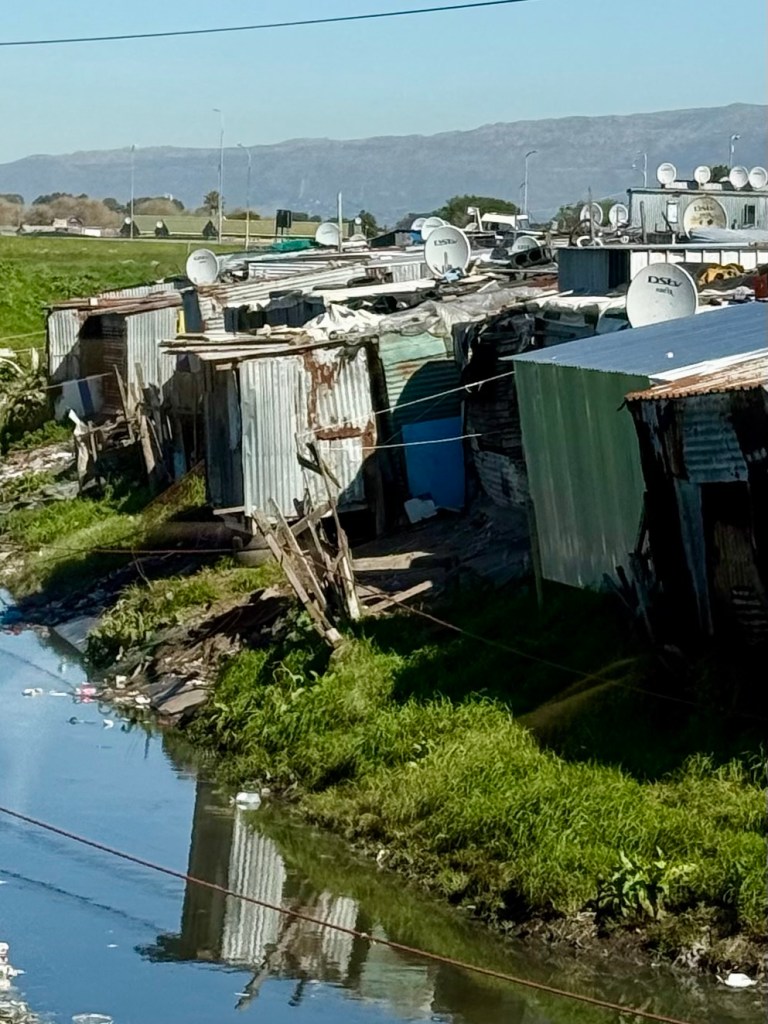
Flush with far from perfect Argentine pesos we head back to the hotel. The rooftop bar and pool is thumping with Techno House music and the Caiparhinas are strong. We watch the sun set and the moon rise over the Iguazu River. Tomorrow we’re going to the Devil’s Throat.
The Iguazu River